
Why depression is really holding potential back
A fresh perspective on depression and effects on life that challenges a common assumption and gives teens a more useful way forward.
 Shadow Borne3 min read
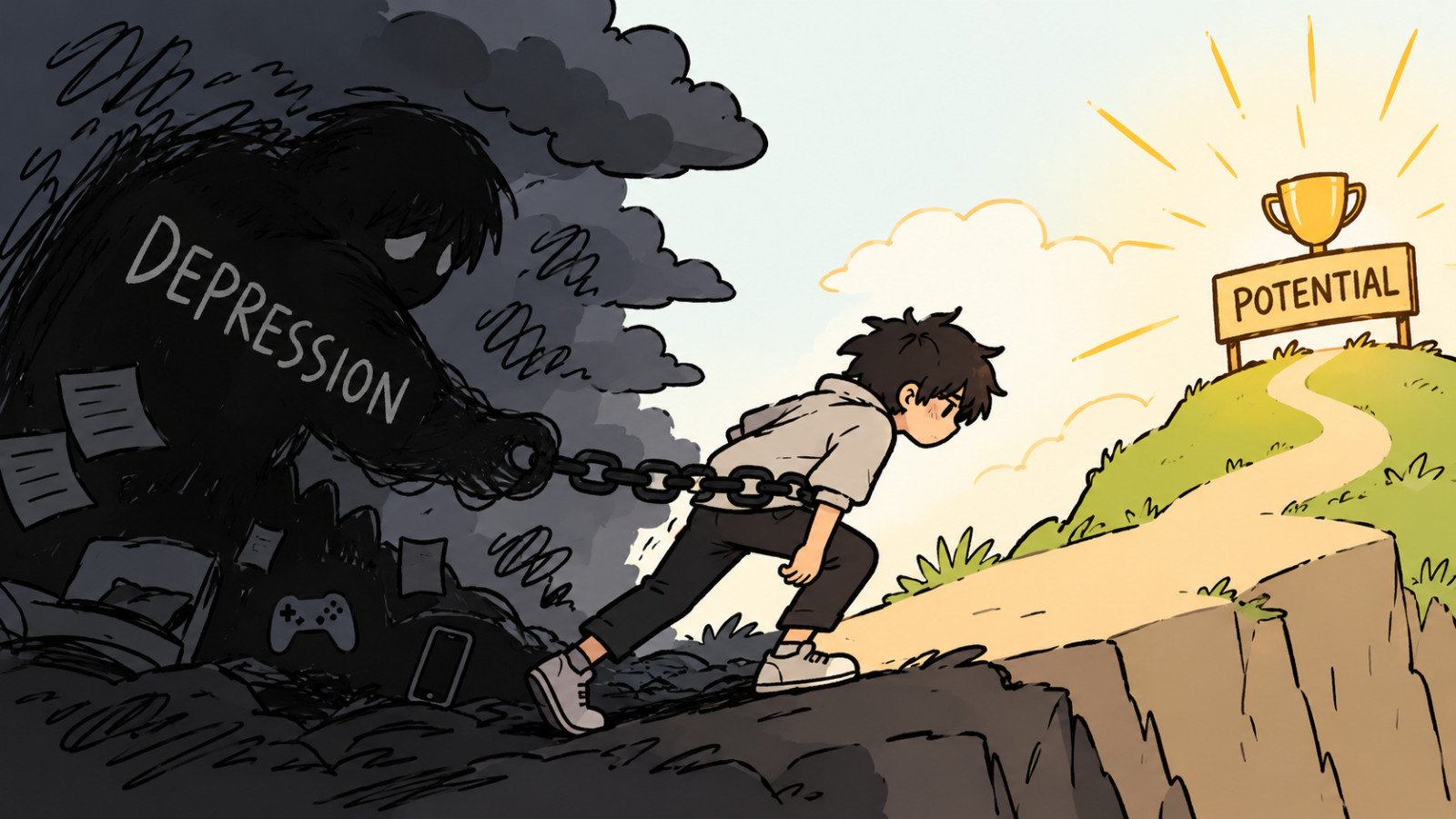
Depression is often misunderstood as sadness, laziness, or a lack of motivation. But what if the real problem is not that teenagers lack potential, but that depression makes it harder for them to access the potential they already have?
The common belief
Many people believe that successful teenagers are the ones who stay disciplined, remain motivated, and work hard regardless of how they feel. From this perspective, depression can look like an excuse for procrastination, poor grades, social withdrawal, or a lack of ambition.
There is some truth in the importance of discipline and consistent effort. However, this view assumes that everyone has roughly the same mental resources available to put those qualities into practice.
Where it breaks down
Depression can affect concentration, memory, energy, sleep, decision-making, and the ability to experience pleasure. Tasks that once felt manageable can begin to feel overwhelming. A teenager who once studied for two hours might struggle to focus for twenty minutes.
Consider a student who wants to become a doctor but begins missing assignments and avoiding friends. Their parents may interpret this as laziness, and the student may start believing that they are simply not good enough. The resulting guilt and isolation can make it even harder to seek help or resume studying.
The overlooked problem is the gap between potential and the ability to use it. Depression can widen that gap, making someone appear less capable than they actually are. Their declining performance is not proof that their potential has disappeared.
A more useful way to think about it
Instead of viewing depression as a failure of character, think of it as a mental health condition that can interfere with a person's ability to function.
Imagine two students with equal academic ability. One has enough energy and concentration to follow a study schedule. The other is experiencing depression and struggles to complete even simple tasks. Giving both students the same advice to “just work harder” ignores the difference in what they are dealing with.
A more useful approach combines realistic expectations, manageable steps, social support, and appropriate professional help. The goal is not to abandon ambition, but to make progress possible under the circumstances.
Depression is treatable, and with appropriate support, people can regain functioning and pursue their goals. Their current struggles do not define their future.
What this changes in practice
For a teenager experiencing these difficulties, the first step is to stop treating every unproductive day as evidence of personal failure.
Shrink the task: Replace “study the whole chapter” with “study for ten minutes.”
Separate performance from self-worth: A poor grade describes a result, not the full measure of your ability.
Build support: Tell a trusted adult, school counsellor, or mental health professional what has been happening, especially if symptoms persist or interfere with daily life.
Adjust expectations without abandoning goals: Recovery and progress do not always follow a straight line.
The central lesson is simple: sometimes, the thing holding a teenager back is not a lack of potential, but a condition that makes that potential harder to access. Recognising the difference can replace shame with understanding and turn an overwhelming problem into a manageable path forward.