What If Instagram and WhatsApp Disappeared From India Tomorrow?
A fresh perspective on What If Instagram and WhatsApp Disappeared From India Tomorrow? that challenges a common assumption and gives you a more useful way forward.
 Gunjan Bodadkar7 min read
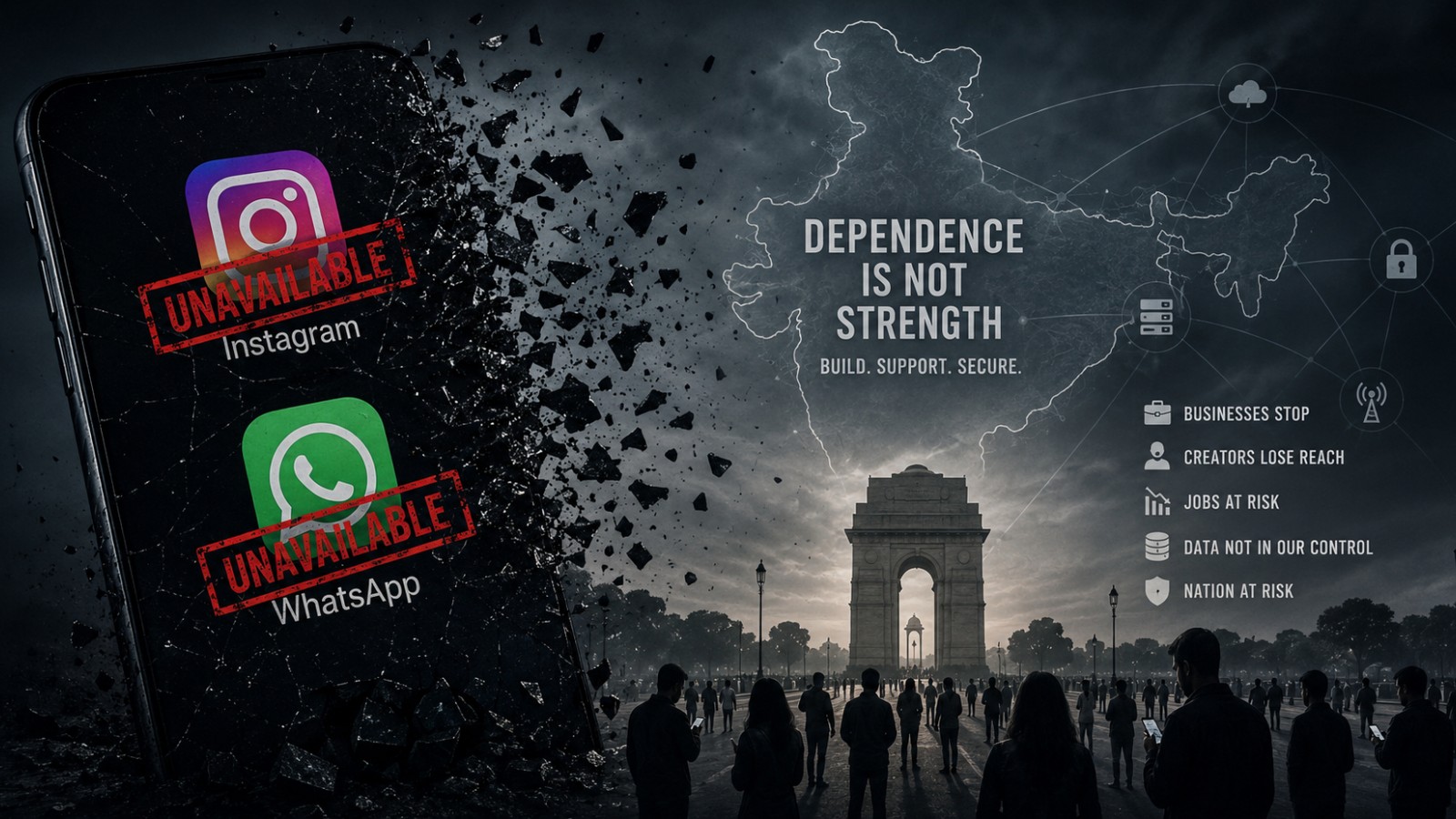
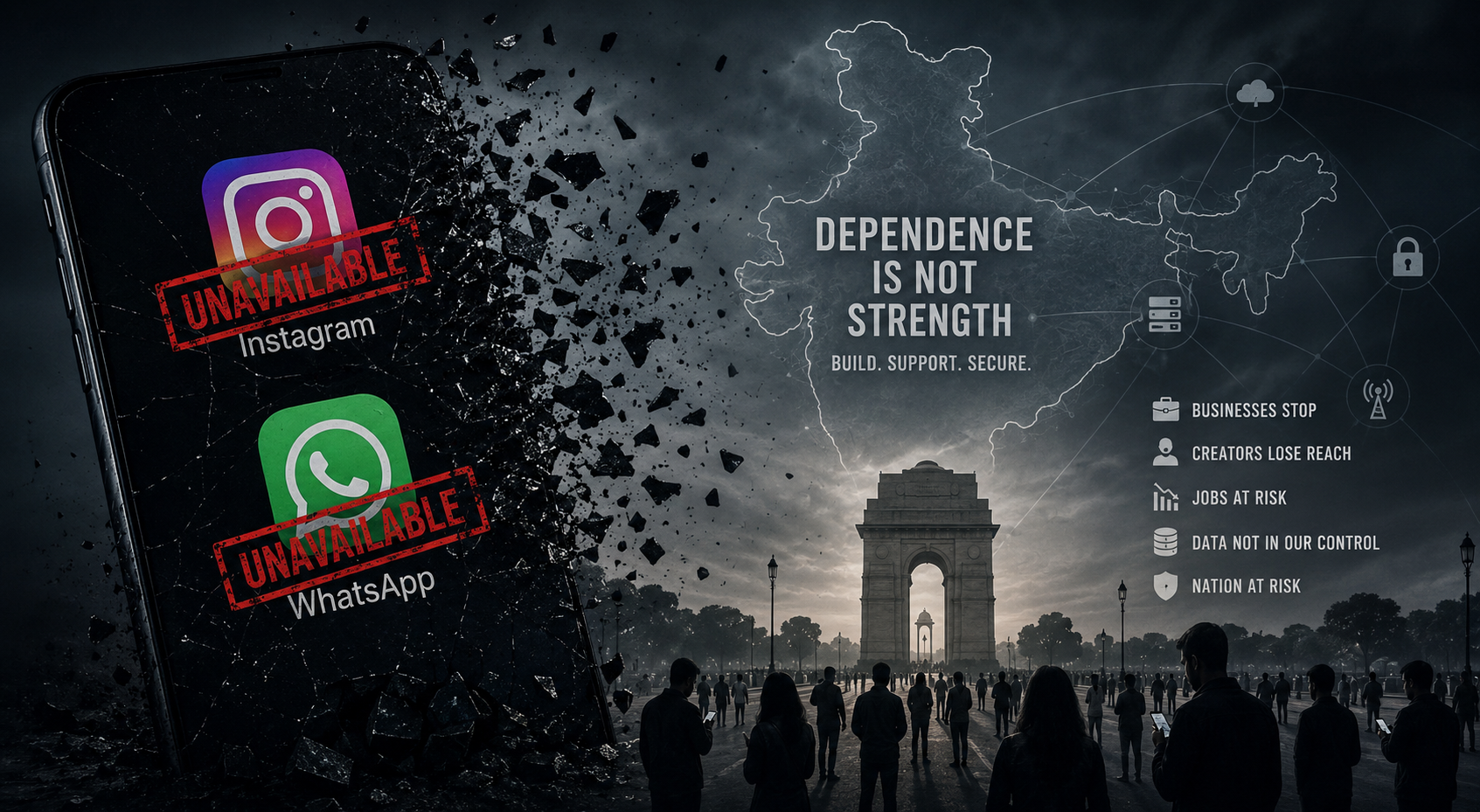
Nothing.
No messages. No family groups. No office groups. No customer conversations. No business updates.
Then you open Instagram.
Nothing again.
For a country of more than a billion people, this would not simply be a social-media problem. It could become a business, communication and economic shock.
And that is exactly why we need to ask an uncomfortable question:
How much of India’s digital life is actually controlled by us?
At first, many people might say, “Nothing much will happen. We will simply move to another app.”
And eventually, perhaps we would.
But the transition would not be painless.
Millions of small businesses communicate with customers through WhatsApp. Companies use WhatsApp groups for employees, vendors and partners. Creators depend on Instagram for audiences and income. Influencers, freelancers, agencies and digital businesses have built entire careers around platforms owned by companies outside India.
If these platforms suddenly disappeared, there would be chaos—not because Indians cannot build alternatives, but because we have become dependent on someone else's infrastructure.
For a few days or even weeks, businesses could struggle to communicate, creators could lose access to their audiences, and millions of people would have to rebuild their digital networks somewhere else.
And that raises a much bigger concern.
What happens when your digital infrastructure isn't yours?
This is not about saying that foreign companies are bad.
The problem is dependency.
Think about the apps and services we use every day.
Our communication can depend on WhatsApp.
Our social-media reach can depend on Instagram.
Our work can depend on Microsoft, Google, Amazon and other foreign technology companies.
Our data can sit on foreign cloud infrastructure.
Our businesses can depend on foreign software.
And that creates something we rarely talk about:
digital vulnerability.
A country can be politically independent and economically powerful, yet still be heavily dependent on technology developed and controlled elsewhere.
And in the modern world, technology is not just convenience.
Technology is power.
We have already seen glimpses of this vulnerability.
In 2025, Indian oil refiner Nayara Energy, which has Russian ownership, faced disruption after Microsoft suspended some of its services following sanctions related to Russia. Microsoft Teams and Outlook became inaccessible to employees, and Nayara approached the Delhi High Court seeking relief. The case became a striking example of how decisions taken by a foreign technology provider can suddenly affect the operations of an Indian company.
Think about what that means.
A company can have employees, offices, factories and physical assets in India—but an important part of its digital operations can still depend on a company sitting thousands of kilometres away.
That is not necessarily a problem when everything is functioning normally.
The problem appears when geopolitics enters the equation.
And geopolitics is increasingly entering technology.
Cyberwarfare makes the situation even more serious.
There was also a major controversy surrounding the Mumbai power outage of October 2020.
Cybersecurity company Recorded Future reported that a China-linked group known as RedEcho had targeted India's power infrastructure with malware. The report raised questions about whether cyber activity was connected to the Mumbai blackout.
However, this is where we need to be precise.
It has not been conclusively established that a Chinese cyberattack caused the Mumbai blackout.
The Maharashtra cyber authorities investigated possible malware activity, while the Union government said its investigation found no conclusive evidence attributing the blackout to a cyberattack and cited human error in the grid failure.
So the lesson is not that “China definitely switched off Mumbai's electricity.”
The more important lesson is this:
Critical infrastructure can be targeted through cyberspace, and India has to be prepared for that possibility.
Power grids, financial systems, telecommunications, hospitals, ports and government infrastructure are increasingly connected to digital systems.
A future conflict does not necessarily have to begin with missiles.
It could begin with servers, malware, networks and data.
And this is where China offers an interesting lesson.
China understood something early:
Digital independence matters.
Instead of allowing every major foreign platform to dominate its internet ecosystem, China built and encouraged domestic alternatives.
WeChat became a massive communication and payments platform.
Weibo became a major social platform.
Baidu became a major search engine.
Alibaba and JD.com became major e-commerce companies.
ByteDance built TikTok internationally while China operates its domestic counterpart, Douyin.
China's model comes with serious trade-offs and is not something India should blindly copy. China's internet is also heavily controlled by the state, with extensive censorship and restrictions on foreign platforms.
But there is one part of the strategy India should study carefully:
Build your own technological capabilities.
Not because foreign technology should be rejected.
But because a country should have alternatives when foreign technology becomes unavailable.
But here's the uncomfortable part.
Indians often say:
“India should build its own WhatsApp.”
“India should build its own Instagram.”
“India needs its own operating system.”
“India needs world-class technology companies.”
But when an Indian company actually tries to build something, what happens?
We often judge it immediately.
The interface isn't perfect.
The app crashes.
The design isn't as good.
The servers are slow.
The company isn't as polished as an American giant.
And then we say:
“Indian companies can't build good products.”
But how exactly do we expect a company to become world-class without millions of users, feedback, investment and time?
No great technology company was perfect on day one.
Even today's biggest technology platforms went through years of development, failures, criticism and improvement.
Technology is built through iteration.
You launch.
People use it.
People complain.
Developers fix it.
Users give feedback.
The product improves.
Then you repeat the process.
That's how ecosystems are built.
This doesn't mean we should blindly support Indian companies.
That's equally dangerous.
“Made in India” should not become an excuse for poor quality.
Indian companies should be held accountable.
They should have to compete.
They should have to innovate.
They should have to protect user data.
They should have to provide better products.
But criticism should be constructive, not destructive.
If an Indian alternative is 70% as good as an established global product today, perhaps the question shouldn't only be:
“Why isn't it as good as WhatsApp?”
The better question might be:
“What would it take to make it 90% as good?”
And then 100%.
Because building technology is not a one-day project.
India cannot suddenly decide tomorrow that it wants its own Google, Microsoft, Instagram, WhatsApp, cloud infrastructure, semiconductor industry and operating system—and expect all of them to appear next year.
It takes decades.
It requires capital.
It requires talent.
It requires research.
It requires infrastructure.
And most importantly, it requires a market willing to give good Indian products a chance.
This is where consumers have an important role.
If an Indian product is genuinely good, use it.
If it has problems, tell the company what needs to improve.
If it fails, understand why.
If it succeeds, support it.
But don't reject something simply because it isn't perfect on day one.
Because the real goal isn't to replace every foreign company.
India doesn't need to isolate itself from the world.
Quite the opposite.
India should continue using the best technology available globally.
But at the same time, India should develop strategic alternatives.
We should be able to communicate if one platform disappears.
We should be able to store critical data without depending entirely on foreign infrastructure.
We should have domestic cloud capabilities.
We should strengthen cybersecurity.
We should build semiconductor capacity.
We should develop AI models and computing infrastructure.
We should create world-class software companies.
And most importantly, we should create an ecosystem where Indian companies can grow from small startups into global technology giants.
Because the objective isn't:
“Don't use foreign technology.”
The objective is:
“Don't become helpless without it.”
Imagine the difference.
If WhatsApp disappeared tomorrow and India had no alternative, we would panic.
If Instagram disappeared tomorrow and creators had nowhere else to go, we would panic.
But imagine an India where multiple strong communication platforms exist.
Where Indian companies have world-class cloud infrastructure.
Where creators can move between platforms without losing their entire audience.
Where businesses have multiple digital communication options.
Where critical government infrastructure has indigenous alternatives.
Then losing one foreign platform would be an inconvenience—not a national vulnerability.
That's technological resilience.
And perhaps that is the bigger conversation India needs to have.
We spend a lot of time talking about becoming a $5 trillion economy, becoming a global superpower and becoming a leader in AI.
But there is another question we need to ask:
Can India continue functioning when the technology it depends on is suddenly taken away?
Because in the future, national power will not be measured only by GDP, military strength or population.
It will also be measured by something far less visible:
Who controls the technology your country depends on?
And if the answer is always someone else, then perhaps we are not as technologically independent as we think.
India doesn't need to build everything alone.
But it does need to make sure that it can stand on its own when it matters.
That is not nationalism.
That is simply digital resilience.