
Beyond Greenwashing: What Does True Sustainability Really Mean
A Thought Before We Begin We live in a world where almost everything is becoming green — green products, green buildings, green businesses, and green promises. But have we stopped to ask what being green actually means? A recyclable label does not necessarily make a product sustainable. A carbon-neutral claim does not automatically make a business environmentally responsible. And using the word eco-friendly does not make an environmental impact disappear. Somewhere between genuine environmental responsibility and clever marketing, the meaning of sustainability is getting lost. Perhaps it is time to look beyond the labels, question the claims, and understand what sustainability truly demands. In a world where everything claims to be green, how do we distinguish genuine sustainability from clever marketing?
.jpeg) Nivedietha Rajkumar7 min read
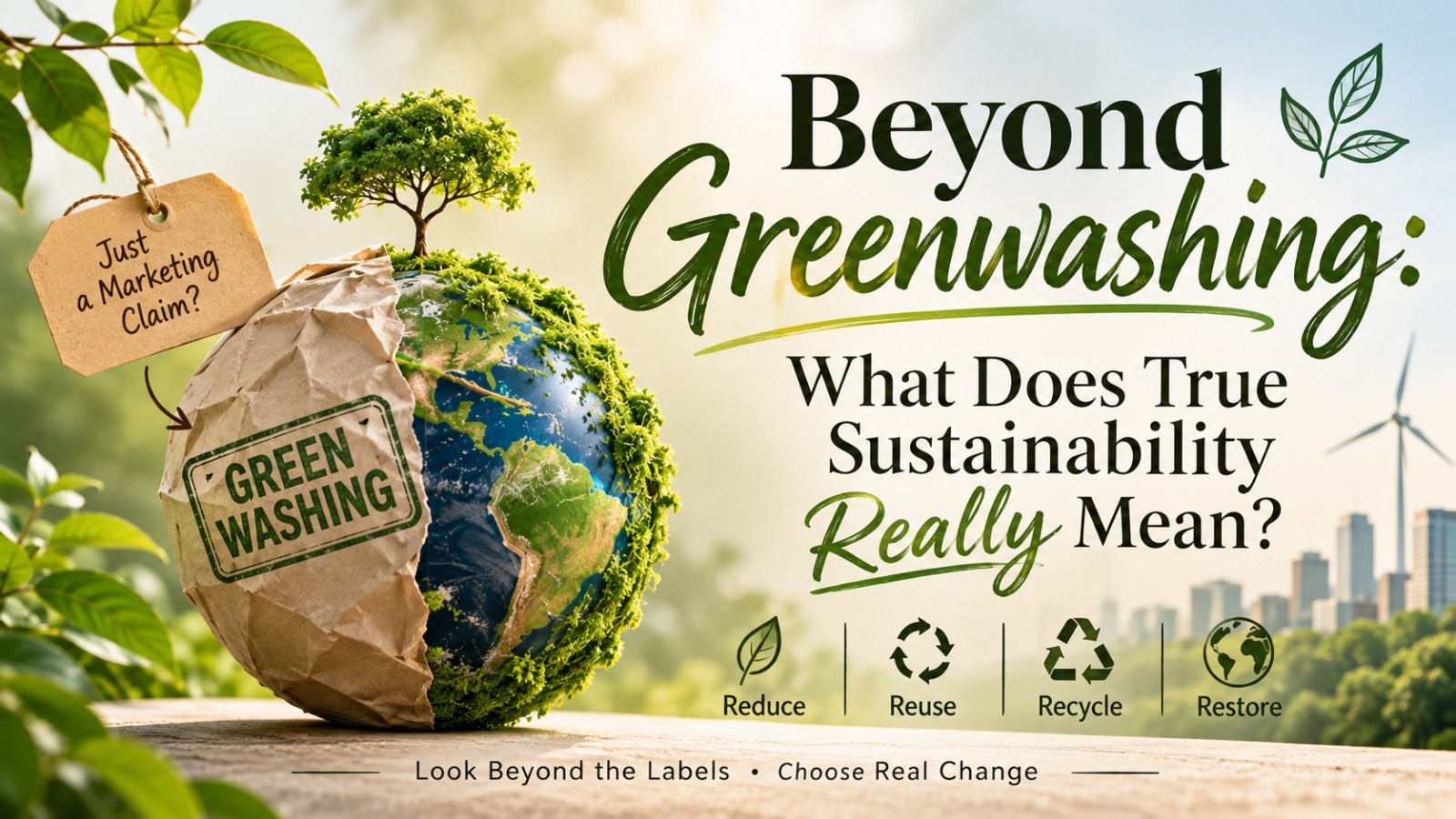
The World Has Turned Green, But Has It Become Sustainable?
Walk into a supermarket, browse an online store, or explore the latest developments in construction, and you will notice something interesting: almost every product or company seems to be going green.
Words such as eco-friendly, sustainable, natural, recyclable, biodegradable, and carbon-neutral have become common features of modern marketing. Businesses proudly display green labels, environmental claims, and sustainability commitments to demonstrate their responsibility towards the planet.
But an important question remains: Are these products and businesses genuinely sustainable, or have we simply made sustainability another marketing strategy?
This is where greenwashing enters the conversation.
As environmental awareness increases, consumers are becoming more conscious of what they purchase and the impact their choices have on the planet. However, the growing popularity of sustainability has also created opportunities for businesses to present themselves as environmentally responsible without making meaningful changes to their operations.
To understand the future of sustainability, we must first look beyond the green labels.
1. Understanding Greenwashing
Greenwashing refers to the practice of misleading consumers about the environmental benefits of a product, service, or organization.
It occurs when companies exaggerate their environmental achievements, make vague sustainability claims, highlight minor improvements while ignoring major environmental impacts, or use attractive green imagery to create an impression of environmental responsibility.
For example, a company might promote its packaging as recyclable while overlooking the environmental impact of manufacturing, transportation, energy consumption, and disposal.
Another company might advertise a product as environmentally friendly simply because it contains a small percentage of recycled material.
The problem is not that these improvements are meaningless. The problem is presenting a limited environmental benefit as proof of overall sustainability.
Greenwashing creates confusion, weakens consumer trust, and makes it difficult for genuinely responsible businesses to stand out.
2. Sustainability Is More Than Just Being Environmentally Friendly
One of the biggest misconceptions about sustainability is that it is limited to environmental protection.
Although protecting the environment is essential, true sustainability is much broader.
It involves three interconnected dimensions:
Environmental sustainability: Protecting natural resources, reducing pollution, lowering greenhouse gas emissions, conserving biodiversity, and minimizing waste.
Social sustainability: Ensuring fair working conditions, human rights, community well-being, health, safety, and equal opportunities.
Economic sustainability: Creating long-term economic value without exhausting natural resources or compromising the ability of future generations to meet their needs.
These three dimensions are commonly discussed as the three pillars of sustainability.
A business cannot claim to be fully sustainable simply because it reduces carbon emissions while ignoring unethical labor practices or unsustainable economic decisions.
True sustainability requires a balanced approach.
3. The Life Cycle Perspective: Looking Beyond the Final Product
A product's environmental impact does not begin when a consumer purchases it, nor does it end when it is discarded.
Every product has a life cycle.
It begins with the extraction of raw materials, continues through manufacturing, packaging, transportation, installation or use, and eventually reaches its end-of-life stage.
At every stage, resources are consumed and environmental impacts are generated.
Consider a building material.
A product may be marketed as sustainable because it is recyclable. However, questions must also be asked:
How were its raw materials extracted?
How much energy was required during manufacturing?
What are its transportation-related emissions?
How long will the material last?
Does it release harmful substances during use?
Can it actually be reused or recycled at the end of its life?
What happens to the material if recycling facilities are unavailable?
These questions reveal why sustainability cannot be judged by a single environmental feature.
Life Cycle Assessment (LCA) provides a systematic method for evaluating the environmental impacts associated with a product throughout its life cycle.
Instead of focusing on one attractive environmental claim, LCA encourages a broader understanding of resource consumption, emissions, waste generation, and other environmental impacts.
This is an important step towards moving from marketing-driven sustainability to evidence-based sustainability.
4. Certifications and Environmental Product Declarations: Separating Claims from Evidence
As sustainability becomes increasingly important, environmental certifications and reporting frameworks play a significant role in helping businesses communicate their environmental performance.
However, not all environmental claims provide the same level of information.
An Environmental Product Declaration (EPD) is a standardized document that communicates quantified environmental information about a product based on Life Cycle Assessment.
EPDs are particularly relevant in the construction industry, where architects, engineers, developers, and sustainability consultants increasingly consider the environmental impacts of building materials.
They can provide information on indicators such as global warming potential, resource use, water consumption, and waste generation.
However, an important distinction must be understood: An EPD does not automatically mean that a product is sustainable.
It provides transparent environmental information that allows informed comparisons and decision-making, subject to factors such as product category rules, declared units, system boundaries, and data quality.
Similarly, certifications and other sustainability standards can help establish credibility, but their meaning depends on what they assess and how their requirements are verified.
The real value of these tools lies in transparency, accountability, and informed choices.
5. From Linear Consumption to a Circular Economy
Traditional economic systems largely follow a linear model:
Take → Make → Use → Dispose
Raw materials are extracted, converted into products, consumed, and eventually discarded.
This model places enormous pressure on natural resources and creates significant amounts of waste.
A circular economy offers a different approach.
Instead of treating products as disposable, it focuses on keeping materials and products in use for as long as possible.
Its principles include:
Designing products for durability and repair.
Reusing products and components.
Reducing unnecessary resource consumption.
Recovering valuable materials.
Improving recycling systems.
Eliminating waste through better design and production.
In the construction sector, circularity can involve designing buildings for adaptability, recovering materials during demolition, reusing structural components, and selecting materials with established recovery pathways.
However, recycling alone does not make an economy circular.
A genuinely circular approach prioritises preventing waste and retaining the value of products and materials before they become waste.
6. The Role of Businesses: From Sustainability Promises to Measurable Action
Businesses have an important responsibility in shaping a sustainable future.
However, sustainability should not exist only in annual reports, advertising campaigns, or corporate presentations.
It must become part of everyday business decisions.
Companies can begin by:
Measuring their environmental impacts using credible methodologies.
Establishing clear and measurable sustainability targets.
Improving energy and resource efficiency.
Reducing waste throughout their supply chains.
Choosing responsible raw materials and suppliers.
Publishing transparent environmental performance data.
Monitoring progress and reporting setbacks honestly.
Most importantly, sustainability commitments must be supported by evidence.
A company claiming to reduce its carbon footprint should be able to explain its baseline, measurement boundaries, reduction strategy, and actual progress.
Transparency is not about presenting a perfect environmental record. It is about being honest about both achievements and challenges.
7. How Can Consumers Identify Genuine Sustainability?
Consumers also have an important role in encouraging responsible production and consumption.
Before accepting an environmental claim, consider asking:
Is the claim specific and measurable?
Is there supporting evidence?
Has the product been assessed across its life cycle?
Is the certification credible and relevant?
Does the company disclose its environmental performance?
Are social and ethical considerations included?
Is the product genuinely better, or is it simply marketed as greener?
Being environmentally conscious does not mean believing every green claim.
It means developing the habit of questioning, understanding, and making informed decisions.
Conclusion: Sustainability Must Be Practised, Not Advertised
Sustainability is no longer just a trend or a competitive advantage. It is becoming an essential responsibility for businesses, governments, industries, and individuals.
However, the increasing popularity of sustainability has also made it easier to confuse environmental marketing with genuine environmental progress.
Green packaging, attractive labels, ambitious promises, and corporate commitments may create a positive image, but they cannot replace measurable action.
True sustainability requires us to look beyond individual products and consider their entire life cycles. It requires responsible resource management, ethical business practices, transparent reporting, and a commitment to long-term environmental and social well-being.
The future does not belong to the companies that make the strongest green claims. It belongs to those willing to demonstrate meaningful progress.
Because being green is a claim. Being sustainable is a responsibility.