
Why Has Being Busy Become a Status Symbol?
In a world obsessed with productivity, has having no time become the new definition of success?
.jpeg) Nivedietha Rajkumar7 min read
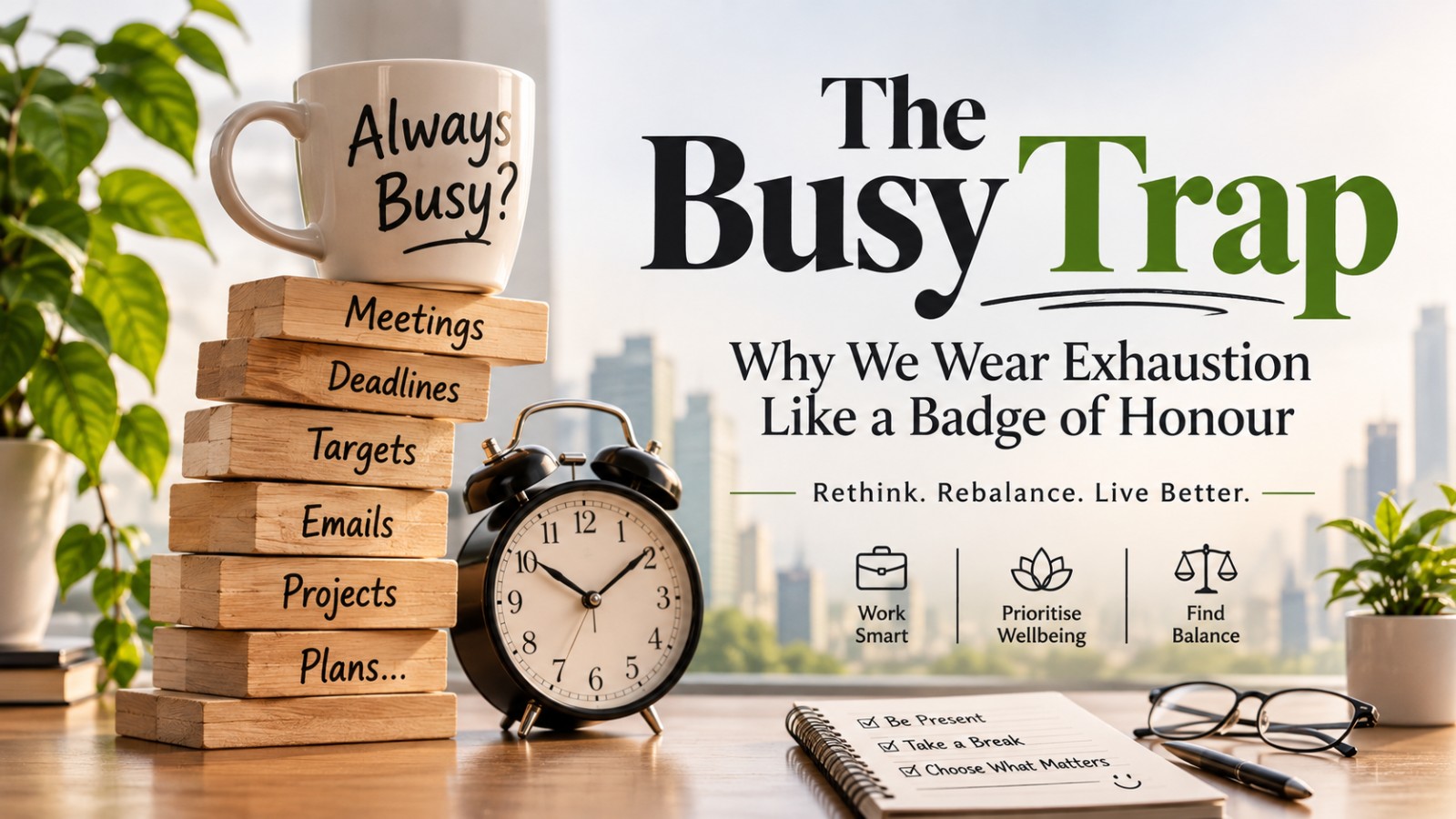
A Thought Before We Begin
When someone asks, "How are you?", how often do we hear the response, "I'm so busy"?
We say it while rushing between meetings, answering emails, completing assignments, managing responsibilities, and trying to keep up with everything happening around us.
Somewhere along the way, being busy became more than just a description of our schedules. It became a way of presenting ourselves.
We have started associating exhaustion with ambition, packed calendars with importance, and having no free time with success.
But when did having time for ourselves become something we feel guilty about?
Perhaps the real question is not why we are so busy, but why we have started treating busyness as an achievement.
Introduction: The Glorification of Being Busy
Take a moment to observe everyday conversations.
Ask someone how their week is going, and there is a good chance their answer will involve a long list of responsibilities. Work deadlines, meetings, projects, errands, personal commitments, and countless other things competing for their attention.
Being busy has almost become a universal language of adulthood.
We often admire people who appear to have endless responsibilities. Their schedules are full, their phones never stop ringing, and their days seem to have no room for rest.
In many professional and social environments, this constant activity is interpreted as ambition, dedication, and importance.
On the other hand, someone who has free time may occasionally feel the need to explain how they are spending it.
It is an interesting contradiction. We spend years wishing for more time, yet when we finally have some, we sometimes feel uncomfortable doing nothing with it.
But is being busy really the same as being productive? And does having no time genuinely make someone more successful?
1. When Busyness Became a Measure of Importance
For a long time, success was commonly associated with visible achievements: a good career, financial stability, recognition, and personal accomplishments.
Today, the appearance of constant activity has become another way people communicate success.
A packed calendar can suggest that someone is in demand. Back-to-back meetings can make an individual appear indispensable. Working late may be interpreted as commitment, even when the additional hours do not necessarily produce better results.
This creates a culture in which people begin to measure their importance through how little availability they have.
The busier someone appears, the more valuable they may seem.
Psychologically, this can become a form of social validation. People receive recognition for being hardworking and constantly occupied, reinforcing the belief that their time must always be filled to be meaningful.
Eventually, busyness stops being something we experience and becomes something we identify with.
2. The Difference Between Being Busy and Being Productive
One of the biggest problems with glorifying busyness is that it confuses activity with progress.
Imagine two people.
The first spends twelve hours working, constantly switching between emails, meetings, messages, and small tasks.
The second spends six focused hours completing meaningful work, making important decisions, and achieving measurable results.
Who is more productive?
The answer is not necessarily the person who worked longer.
Being busy means having many things to do. Being productive means making meaningful progress towards something.
Constant activity can sometimes become a distraction from the work that genuinely matters.
We fill our schedules because having something to do makes us feel useful. Yet some of the most important achievements require uninterrupted concentration, thoughtful decision-making, and the ability to prioritise.
Productivity is not about doing everything. It is about recognising what deserves our attention.
3. The Influence of Social Media and the Hustle Culture
Social media has given busyness a new platform.
We regularly see people sharing their early morning routines, gym sessions, work schedules, business ventures, reading goals, side hustles, and professional achievements.
There is nothing inherently wrong with sharing these experiences. However, constant exposure to carefully presented productivity can create unrealistic expectations.
We begin comparing our ordinary days with someone else's carefully selected highlights.
A productive morning becomes a standard we feel pressured to achieve. A successful entrepreneur's schedule becomes a model we believe we should follow. Even rest can start feeling like wasted potential.
This is where hustle culture becomes influential.
Hustle culture promotes the idea that success requires continuous effort, relentless ambition, and the willingness to sacrifice personal time.
While hard work certainly matters, the problem begins when working constantly becomes an expectation rather than a choice.
We start believing that if we are not improving, earning, learning, building, or achieving something, we are falling behind.
And suddenly, simply living seems insufficient.
4. The Hidden Cost of Always Being Busy
The glorification of busyness often hides its consequences.
When every hour is occupied, something inevitably gets sacrificed.
It might be sleep, relationships, physical activity, personal interests, or simply the opportunity to sit quietly and think.
Constantly switching between responsibilities can also make it difficult to concentrate. Instead of giving our attention to one meaningful task, we divide it across multiple demands.
Over time, this pattern can contribute to stress, emotional exhaustion, and burnout.
The World Health Organization recognises burnout as an occupational phenomenon resulting from chronic workplace stress that has not been successfully managed.
But the consequences are not limited to professional life.
When people become accustomed to measuring their worth through productivity, even their personal lives can begin to feel like another checklist.
Reading becomes a self-improvement target. Exercise becomes a performance metric. Hobbies become opportunities to develop another skill.
Even relaxation starts requiring justification.
The irony is that in trying to make every moment productive, we may lose the ability to enjoy the moments themselves.
5. Why Do We Feel Guilty About Doing Nothing?
Perhaps one of the most interesting aspects of modern busyness is the guilt associated with rest.
Consider a Sunday afternoon with absolutely nothing planned.
Instead of enjoying the free time, some people immediately begin thinking about unfinished work, pending responsibilities, or things they could be doing to improve themselves.
Why?
Part of the answer lies in how deeply productivity has become connected to personal identity.
When society repeatedly rewards achievement and visible effort, we may begin internalising the idea that our value depends on what we accomplish.
Rest can then feel like laziness, even when it is necessary.
There is also the fear of falling behind.
When everyone around us appears to be moving forward, slowing down can create anxiety. We worry that taking a break might mean losing an opportunity or becoming less competitive.
But rest is not the opposite of ambition.
It is an essential part of maintaining the energy, clarity, and creativity required to pursue meaningful goals.
6. The Importance of Reclaiming Our Time
The solution is not to stop being ambitious or abandon responsibilities.
It is to reconsider our relationship with time.
Instead of measuring a day by how many tasks we complete, we can begin evaluating it by whether we made meaningful progress and maintained a healthy balance.
This might involve:
Prioritising important tasks instead of trying to complete everything.
Setting boundaries between professional and personal life.
Allowing time for activities that have no productive outcome.
Taking breaks without feeling the need to justify them.
Recognising that being unavailable does not make someone less valuable.
Understanding that personal growth does not have to happen every single day.
Most importantly, we need to become comfortable with having time that belongs to nobody but ourselves.
A quiet evening, an unplanned weekend, a long conversation, or an afternoon spent doing absolutely nothing can be just as valuable as a day filled with accomplishments.
Not every moment needs to contribute to a larger goal.
Some moments are worth experiencing simply because they are ours.
Conclusion: You Don't Have to Be Busy to Be Important
Perhaps we have misunderstood what success is supposed to look like.
We have started celebrating exhaustion, comparing schedules, and treating constant activity as proof that we are moving forward.
But a full calendar does not necessarily represent a fulfilling life.
Being busy does not automatically mean being productive. Being unavailable does not make someone important. And having time to rest does not mean someone lacks ambition.
There is nothing wrong with working hard, pursuing goals, or wanting to achieve more.
The problem begins when we become so occupied with proving our productivity that we forget to enjoy the life we are working so hard to build.
Maybe the ultimate sign of success is not having every minute occupied.
Maybe it is having the freedom to decide what deserves our time.
Because a meaningful life is not measured by how busy we are, but by how intentionally we choose to live it.