Why We Still Love Vinyl, Film Cameras, and Paper Notebooks
What you'll get from this piece: the real reasons analog objects are winning people back, what research says about longing for eras you never lived through, and a few small experiments to find out what your own pull toward the past is telling you.
.jpeg) Nivedietha Rajkumar5 min read
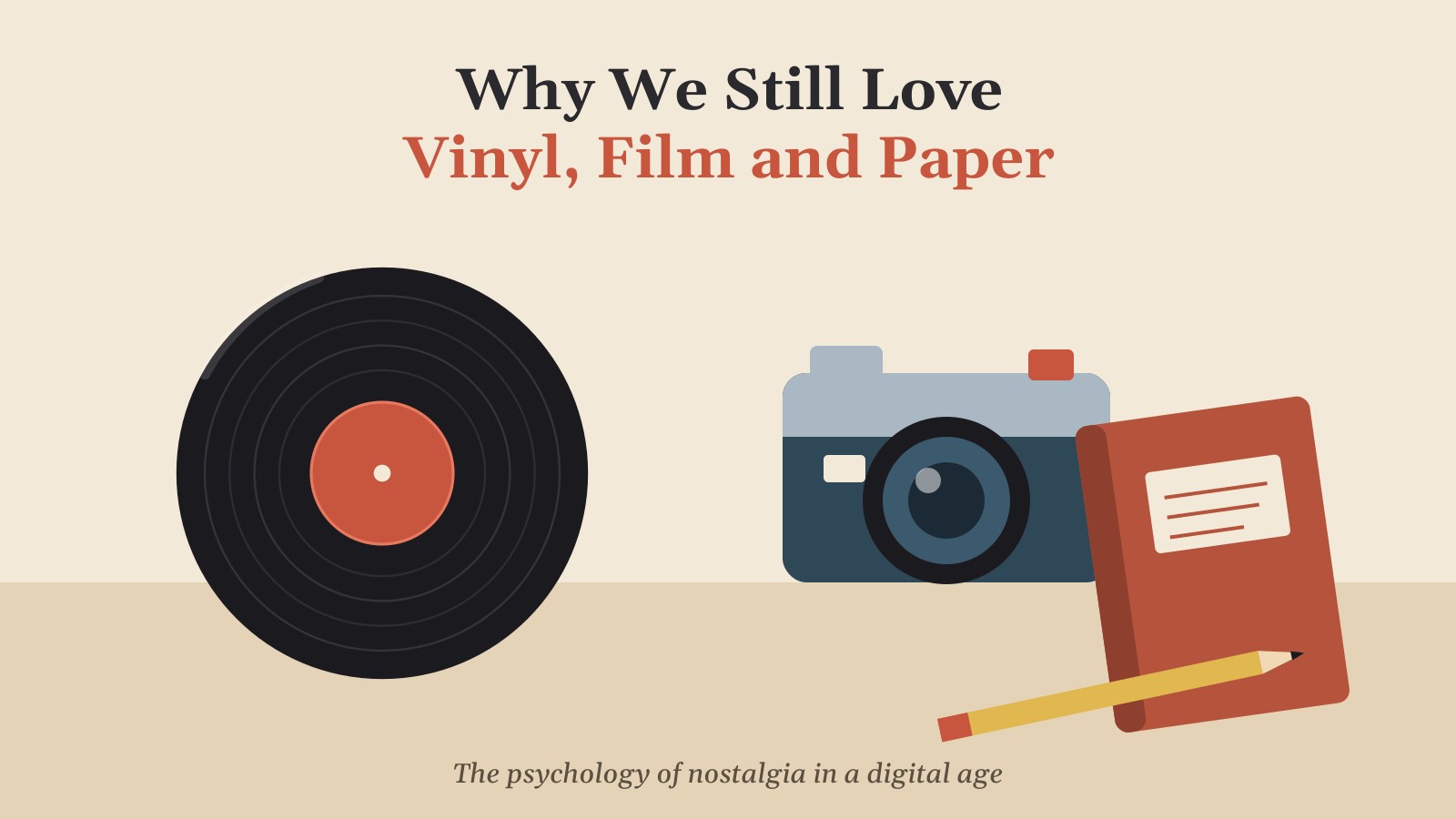
The psychology of nostalgia in a digital age
Your phone can play every song ever recorded, take a thousand photos before lunch, and store a lifetime of notes. So why are people lining up for turntables, loading rolls of film, and buying beautiful notebooks they have to write in by hand?
It is tempting to call it a hipster fad. But the comeback of analog objects has lasted too long, and cuts across too many age groups, to be just a trend. Something deeper is going on, and psychology has a few good explanations.
The comeback is real
In 2022, vinyl records outsold CDs in the United States by revenue for the first time since the late 1980s. Film stock, once declared dead, has returned to production lines, and disposable and compact film cameras have become sought-after items among people who were not born when they were common. Stationery brands and bullet-journal communities keep growing, even as note-taking apps get smarter every year.
The surprising part is who is buying. Much of the growth comes from younger people who never owned these things the first time around. That matters, because it means this is not simply grown-ups longing for their own childhoods.
Nostalgia is not what we thought it was
For centuries, nostalgia was treated as a medical problem. The term was coined in the 17th century to describe the homesickness of soldiers, and it was considered a kind of illness well into the modern era.
Modern research paints a very different picture. Psychologists who study nostalgia, including Constantine Sedikides and his colleagues, have found that it tends to increase feelings of social connection, boost mood, and give people a stronger sense that their lives have meaning. Nostalgia, it turns out, is less an escape from the present than a resource for coping with it.
And there is a twist: you can feel nostalgic for a time you never lived through. Researchers call this anemoia, or sometimes vicarious nostalgia. A twenty-year-old with a film camera may be longing for an era known only through photographs, films, and the stories of parents and grandparents.
Friction is the feature
Digital tools are built to remove effort. Streaming gives you everything instantly. A phone camera lets you shoot endlessly and delete freely. A notes app lets you rewrite without a trace.
Analog tools do the opposite, and that is exactly the appeal.
Vinyl asks you to choose an album, take it out of its sleeve, and lower the needle. You are more likely to listen to a whole side, in order, as the artist intended.
Film gives you a limited number of frames. Each shot costs money and cannot be previewed, so you slow down and look more carefully.
Paper cannot be undone with a keystroke. Handwriting is slower than typing, and some studies suggest that slower note-taking can help people process and remember ideas rather than copy them down.
This connects to what psychologists call the effort justification effect: we tend to value things more when we have put effort into them. A photo you waited a week to see developed feels more precious than one of a thousand on your phone.
Owning something you can touch
There is also the problem of digital abundance. When everything is available, nothing feels special. Your music library has no shelf, your photos have no weight, and your notes have no smell or texture.
Physical objects offer what researchers sometimes call tangibility: they exist in space, they age, and they carry traces of use. A dog-eared notebook or a scratched record becomes a small record of your own life. Collectors often say that part of the joy is the ritual, from flipping through crates to labelling a roll of film. The object is the memory's anchor.
A quiet rebellion against the always-on world
For many people, analog hobbies are also a way of reclaiming attention. A turntable does not send notifications. A paper notebook cannot show you ads. Choosing these tools is a small act of boundary-setting in a world that rarely lets us disconnect.
This is why the trend feels less like a rejection of technology and more like a correction. People are not abandoning their phones. They are carving out pockets of life where technology is not in charge.
It is also a little bit about identity
We should be honest: there is a status element too. Analog hobbies can signal taste, patience, and individuality. In an age when everyone has the same phone, a vintage camera or a rare pressing says something about who you are. That does not make the love any less genuine, but it is part of the picture, and it helps explain why these products have been so successfully marketed.
What we are really longing for
Put all of this together and a clear theme emerges. We do not love vinyl, film, and paper because they are better. A streaming service has better sound convenience, a phone has better image quality, and an app has better search. We love them because they give us things convenience cannot: attention, ritual, patience, and a feeling of presence.
Nostalgia in the digital age is not really about the past. It is a signal about what the present is missing.
If you feel the pull yourself, you do not need to buy anything expensive to test it. Try listening to one full album without skipping, shooting a single roll of film, or writing your to-do list by hand for a week. Notice what changes. The answer may tell you more about what you want from your digital life than any trend piece could.