
Nalanda Mahavihara: The Ancient University That Became a Beacon of Knowledge
Exploring the rise, intellectual brilliance, international influence and destruction of one of the greatest centres of learning in ancient India.
.jpeg) Nivedietha Rajkumar13 min read
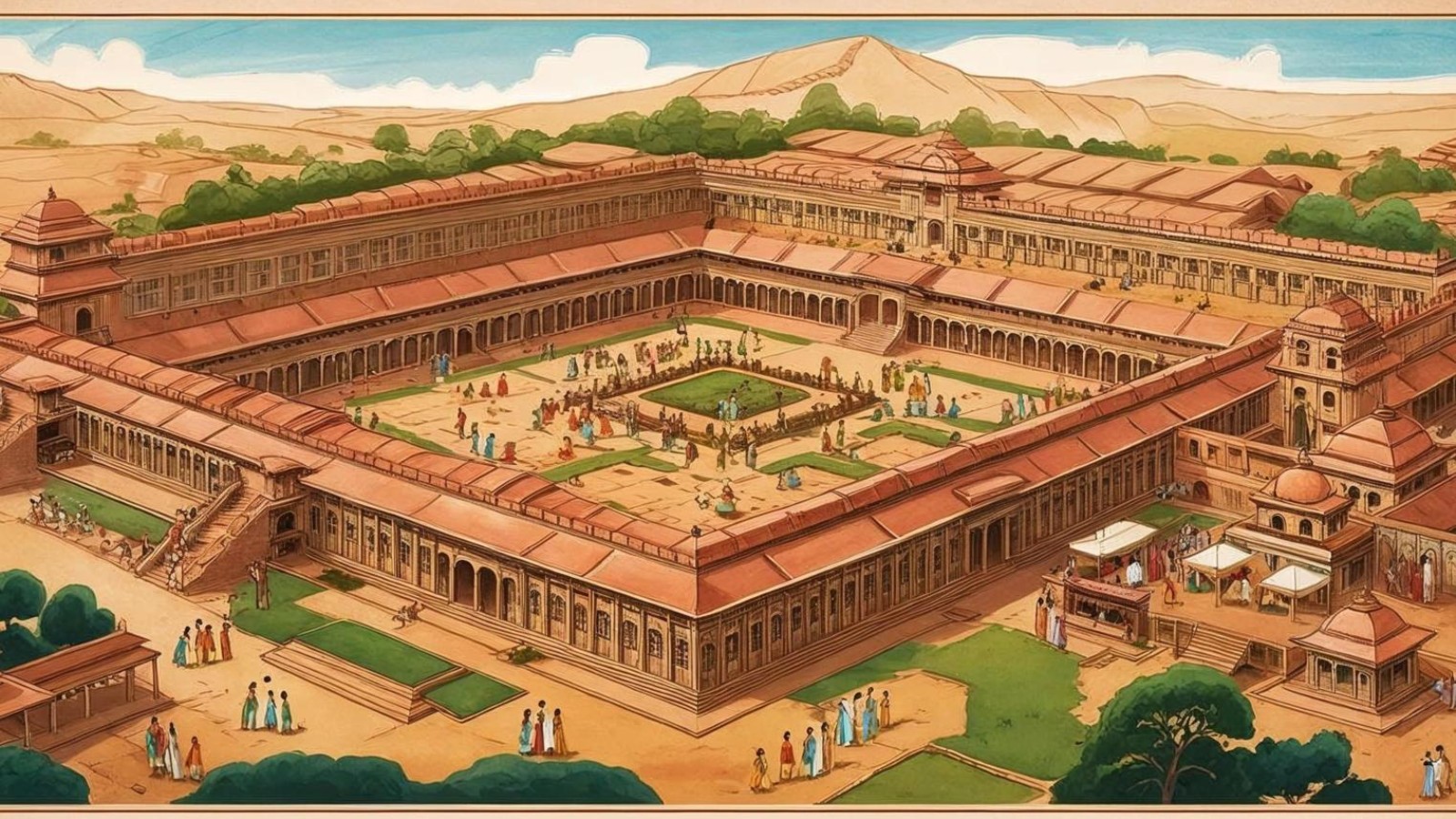
Long before universities became an established feature of modern society, ancient India was home to extraordinary institutions dedicated to education, philosophy, science and intellectual debate. Among them, few achieved the reputation and international influence of Nalanda Mahavihara, located in present-day Bihar.
For centuries, Nalanda stood as one of the most celebrated centers of Buddhist scholarship and higher learning in Asia. It attracted students, monks and scholars from distant regions, including China, Tibet, Korea and Southeast Asia. Its classrooms and monasteries became places where religious traditions were studied, philosophical arguments were examined and knowledge was preserved through generations.
Nalanda was more than a religious institution. It represented an organized intellectual community in which education, research, debate and spiritual development existed together.
Its story, however, is not simply one of greatness. It is also a story of royal patronage, international connections, extraordinary scholarship, political upheaval and destruction.
How did a university established more than a thousand years ago become internationally renowned? What did students study there? How did it attract scholars from across Asia? And what happened to an institution that had once represented the intellectual achievements of ancient India?
To understand Nalanda is to explore an important chapter in the history of Indian education and the wider history of human knowledge.
1. The Origins of Nalanda: The Birth of a Great Learning Centre
Nalanda's origins are generally associated with the Gupta period, particularly the fifth century CE. Although Buddhist traditions connect the surrounding region with the life of Gautama Buddha and his chief disciples, the establishment of Nalanda as a major monastic institution took place much later.
The Gupta dynasty played an important role in supporting intellectual, artistic and religious developments across northern India.
Nalanda is traditionally associated with the patronage of Kumaragupta I, who ruled during the fifth century CE. The identification is supported by historical and archaeological evidence, although the institution developed over several centuries rather than being the creation of a single ruler.
Its name, Nalanda, has been interpreted in different ways in traditional accounts. One popular explanation associates it with the idea of an inexhaustible gift of knowledge.
From its early beginnings, Nalanda gradually developed into a large monastic complex with residential facilities, temples, stupas and spaces dedicated to scholarly activities.
Unlike a small religious monastery, it eventually became an extensive educational establishment with a reputation that extended far beyond the Indian subcontinent.
2. The Golden Age: Royal Patronage and the Expansion of Nalanda
Nalanda's growth was closely connected with the support it received from powerful Indian rulers.
After the Gupta period, the institution continued to receive patronage from different dynasties, particularly the Palas of Bengal and Bihar, who were significant supporters of Buddhist institutions.
Royal donations helped maintain monasteries, support teachers, provide resources for students and expand the institution's physical infrastructure.
Land grants and donations from wealthy individuals and communities also contributed to its development.
During its flourishing period, Nalanda became a major center for Buddhist learning, particularly Mahayana Buddhist philosophy. It also engaged with broader traditions of Indian intellectual thought.
Its reputation grew through the movement of scholars and religious travelers who carried knowledge, manuscripts and teachings between India and other parts of Asia.
Nalanda was not built in a single generation. It evolved through successive phases of construction, expansion and institutional development.
This long history helps explain why its archaeological remains reveal such an extensive and complex educational settlement.
3. Inside Nalanda: What Did the Ancient University Look Like?
Nalanda was an enormous residential monastic complex rather than a single university building.
Archaeological excavations have revealed a carefully organized settlement containing monasteries, temples, stupas, courtyards, cells and other structures.
Its architectural layout reflected the needs of a large community of monks and scholars.
The monasteries
The residential monasteries contained rooms arranged around central courtyards. These spaces provided accommodation for monks and students, along with areas for study and religious activities.
The temples and stupas
Numerous religious structures formed an important part of the complex. They were used for worship, meditation and the commemoration of important Buddhist figures and teachings.
The learning spaces
The institution's educational life was closely connected with its monastic environment. Instruction, discussions, recitation and philosophical debate took place within this larger community.
The water systems
Archaeological remains also reveal wells, drains and other facilities that supported daily life within the institution.
Nalanda was therefore not simply a collection of classrooms. It was a functioning residential and religious settlement designed to support a substantial scholarly population.
4. The Admission Process: Not Everyone Could Enter Nalanda
One of the most remarkable aspects of Nalanda was its reputation for rigorous intellectual standards.
Admission was not simply a matter of arriving at the monastery and requesting a place. Historical accounts describe a demanding selection process in which prospective students were expected to demonstrate their knowledge and understanding before being accepted.
According to Xuan Zang's account, candidates faced questions from learned scholars who examined their intellectual abilities.
Those seeking admission were expected to possess a strong foundation in Buddhist teachings, philosophy and related subjects.
The institution attracted students from different regions, and its reputation meant that gaining entry was considered a significant achievement.
Nalanda's educational environment placed considerable importance on intellectual discipline. Students were expected to participate in discussions, listen to teachers, examine philosophical arguments and defend their interpretations.
The emphasis on debate and reasoning made it more than a place for memorizing religious texts. It was an institution where ideas were examined, challenged and developed.
UNESCO's historical documentation also identifies entrance examinations, formal administration and recognized scholarly qualifications among the features of Nalanda's institutional system
5. What Did Students Study at Nalanda?
Although Nalanda was primarily a Buddhist Mahavihara, its intellectual activities extended into several areas of knowledge.
Its curriculum reflected the broad scholarly traditions of ancient India.
Buddhist philosophy
Students studied Buddhist scriptures, philosophical interpretations, the nature of existence, suffering, consciousness and the path towards liberation.
Different Buddhist philosophical schools were represented, particularly Mahayana traditions.
Logic and debate
Logic was an important part of intellectual training. Students learned to construct arguments, examine opposing viewpoints and identify weaknesses in philosophical reasoning.
Debate was not merely an academic exercise; it was an important method of developing and testing knowledge.
Grammar and languages
The study of Sanskrit grammar and linguistic traditions helped students interpret complex religious and philosophical texts.
Medicine
Medical knowledge formed part of the wider intellectual environment of ancient Indian learning. The study of healing traditions was important in the broader Buddhist scholarly world.
Mathematics and astronomy
Mathematical and astronomical knowledge also formed part of the wider Indian intellectual tradition. However, the precise extent of formal instruction in these subjects at Nalanda is not fully documented.
Other philosophical traditions
Students encountered ideas beyond a single religious interpretation. The study of different philosophical systems helped create an environment of comparison, discussion and intellectual examination.
Nalanda's significance therefore lay not only in preserving Buddhist teachings but also in participating in the wider scholarly culture of ancient India.
6. The Great Library: The Knowledge Preserved at Nalanda
Among the most fascinating elements of Nalanda's history is its famous library, traditionally associated with the name Dharmaganja, meaning the Treasury of Truth.
Historical and literary traditions describe an extensive collection of Buddhist manuscripts and scholarly works.
The library is often associated with three named buildings:
Ratnasagara – the Ocean of Jewels.
Ratnodadhi – the Sea of Jewels.
Ratnaranjaka – the Adorned with Jewels.
These names have become an important part of the popular historical imagination surrounding Nalanda.
The library is believed to have contained religious scriptures, philosophical commentaries, manuscripts and other scholarly works.
In an age before printing became widespread, manuscripts were painstakingly copied by hand. The preservation of texts depended on the work of scholars, scribes and religious communities.
Libraries such as Nalanda's therefore played a crucial role in protecting intellectual traditions.
The exact architectural details, size and organisation of its library are not fully established by surviving archaeological evidence. Nevertheless, historical accounts and the institution's scholarly reputation indicate the importance of manuscript preservation.
The loss of Nalanda consequently represents more than the destruction of buildings. It also raises questions about the loss and dispersal of valuable written knowledge.
7. Xuanzang: The Chinese Scholar Who Studied at Nalanda
Perhaps no historical figure is more closely associated with Nalanda than the Chinese Buddhist monk Xuanzang.
Born in China during the seventh century, Xuanzang travelled to India to study Buddhist teachings and obtain original religious texts.
His journey was extraordinary. Travelling across difficult geographical regions and political territories, he eventually reached India, where he visited several important Buddhist centres.
Nalanda became one of the most significant destinations of his journey.
There, Xuanzang studied under the renowned scholar and abbot Shilabhadra, who was associated with the Yogachara school of Buddhist philosophy.
Xuanzang spent several years studying Buddhist scriptures, Sanskrit, philosophy and other subjects.
His experiences at Nalanda helped shape his understanding of Indian Buddhism.
After returning to China, he translated numerous Buddhist texts into Chinese and became one of the most influential figures in the transmission of Buddhist knowledge between India and East Asia.
His writings, particularly the Great Tang Records on the Western Regions, provide valuable information about the political, geographical, religious and educational conditions of seventh-century India.
His account offers an important window into Nalanda at the height of its international reputation.
8. Nalanda's International Connections: A University Without Borders
Nalanda's influence was not restricted to India.
It developed into an international centre of Buddhist learning, attracting scholars and monks from different parts of Asia.
Students and religious travellers came from regions including:
China
Tibet
Korea
Sri Lanka
Southeast Asia
One important visitor was Yijing, another Chinese Buddhist monk who travelled to India during the seventh century.
Yijing spent several years studying at Nalanda and later recorded valuable information about Buddhist education, monastic discipline, religious practices and daily life.
His writings provide additional evidence of the institution's international connections.
These journeys were not simply religious pilgrimages. They were also intellectual exchanges.
Scholars carried manuscripts, translated texts, learned new philosophical interpretations and introduced Indian Buddhist traditions to other regions.
Nalanda therefore functioned as part of a much wider network of knowledge connecting South Asia with the rest of Asia.
Its influence can still be recognised in the development of Buddhist philosophy, religious institutions and manuscript traditions across the continent.
9. The Pala Dynasty and the Continued Flourishing of Nalanda
After the decline of Gupta political power, Nalanda continued to develop under subsequent rulers.
The Pala dynasty, which dominated large parts of eastern India between approximately the eighth and twelfth centuries, played a particularly important role in supporting Buddhist institutions.
Pala rulers supported monasteries, temples, scholars and artistic traditions.
During this period, Nalanda remained an important centre of Buddhist scholarship, while other major institutions also developed.
These included:
Vikramashila Mahavihara, another prominent Buddhist educational institution in present-day Bihar.
Odantapuri Mahavihara, an important monastic centre associated with Pala patronage.
Somapura Mahavihara, located in present-day Bangladesh, which became a major Buddhist architectural and educational centre.
These institutions formed part of an interconnected intellectual landscape.
Nalanda was no longer the only important centre of Buddhist learning, but it continued to hold considerable historical and religious significance.
The Pala period also witnessed the development of Buddhist art, sculpture and architectural styles that influenced regions beyond India.
10. The Destruction of Nalanda: The End of an Era
One of the most tragic chapters in Nalanda's history is its destruction and eventual abandonment during the thirteenth century.
The decline of the institution was connected with the political and military upheavals that affected northern and eastern India during this period.
The raids associated with the Turkic military commander Bakhtiyar Khalji are frequently associated with the destruction of major Buddhist monastic centres in Bihar.
Historical accounts, including later narratives about the conquest of Bihar, describe attacks on large monastic establishments and the killing or displacement of Buddhist monks.
Nalanda's decline, however, should not be understood as a single isolated event that instantly ended all educational activity.
The institution had already experienced changing patterns of political support, and its decline took place within a wider period of political instability and weakening Buddhist monastic networks in eastern India.
Some accounts suggest that limited monastic activity continued even after the major attacks.
Nevertheless, the destruction and abandonment of Nalanda marked the end of one of the most extraordinary periods in the history of Indian Buddhist education
Did the library burn for months?
A popular story claims that Nalanda's library burned for several months because of the enormous quantity of manuscripts it contained.
Although this story is widely repeated, the exact duration of the fire and the detailed circumstances of the library's destruction cannot be independently established through reliable contemporary evidence.
It is better to distinguish the well-documented destruction of Buddhist institutions from later dramatic accounts about the library.
What is certain is that the decline of Nalanda represented a tremendous loss to India's Buddhist and intellectual heritage.
11. Rediscovering Nalanda: From Forgotten Ruins to World Heritage
For centuries, the remains of Nalanda lay buried beneath layers of earth and vegetation.
Its historical identity survived through Buddhist writings, travel accounts and literary traditions, but the physical extent of the institution gradually disappeared from public view.
During the nineteenth century, British archaeologists and historians began investigating the ancient remains of the region.
The work of Alexander Cunningham and subsequent archaeological investigations helped identify the ruins with the Nalanda described in historical accounts.
Systematic excavations by the Archaeological Survey of India during the twentieth century revealed monasteries, temples, stupas, sculptures, inscriptions, seals and other artefacts.
These discoveries provided physical evidence of Nalanda's extraordinary development.
In 2016, UNESCO recognised the archaeological site of Nalanda Mahavihara as a World Heritage Site.
The designation acknowledged its exceptional importance in the development of monastic education, Buddhist architecture and intellectual exchange across Asia
Today, the archaeological complex preserves an important part of India's educational and cultural heritage.
12. The New Nalanda University: Reviving an Ancient Legacy
The legacy of Nalanda did not remain confined to archaeological ruins.
In the twenty-first century, the idea of reviving Nalanda as an international centre of higher education gained renewed attention.
The modern Nalanda University was established in 2010 through an initiative supported by India and other participating countries of the East Asia Summit.
Located in Rajgir, Bihar, the university draws inspiration from the international and intellectual traditions of ancient Nalanda.
It aims to encourage international academic cooperation, research and interdisciplinary education.
The modern university is not a direct institutional continuation of the ancient Mahavihara. Rather, it represents an effort to revive the spirit of international scholarship and intellectual exchange associated with the historical institution.
The connection between the two is symbolic but significant: both reflect the idea that knowledge should move beyond geographical and cultural boundaries.
Conclusion: When Knowledge Became a Civilisation's Greatest Legacy
Nalanda Mahavihara was much more than an ancient Buddhist monastery. It was an extraordinary intellectual institution that brought together scholars, students and religious thinkers from different parts of Asia.
Its educational traditions encouraged philosophical debate, manuscript preservation, disciplined study and the exchange of ideas.
Its influence extended far beyond its physical boundaries, shaping Buddhist scholarship and intellectual traditions across the Asian continent.
Its destruction marked a tragic chapter in Indian history, but its legacy could not be erased completely.
The manuscripts may have been lost, its monasteries reduced to ruins and its classrooms silenced, yet the knowledge carried by its scholars continued to travel across borders.
Today, Nalanda stands as a reminder that India's history was not shaped only by kings, kingdoms and battles. It was also shaped by teachers, philosophers, monks, students and institutions that devoted themselves to understanding the world.
Perhaps Nalanda's greatest achievement was not the number of students it educated or the manuscripts it preserved, but the idea it represented: that knowledge belongs to humanity, and its pursuit should have no boundaries.