
The Lost River Saraswati: Myth, Mystery and the River That Disappeared
An exploration of India's legendary river, its place in ancient scriptures, and the search for its historical existence.
.jpeg) Nivedietha Rajkumar9 min read
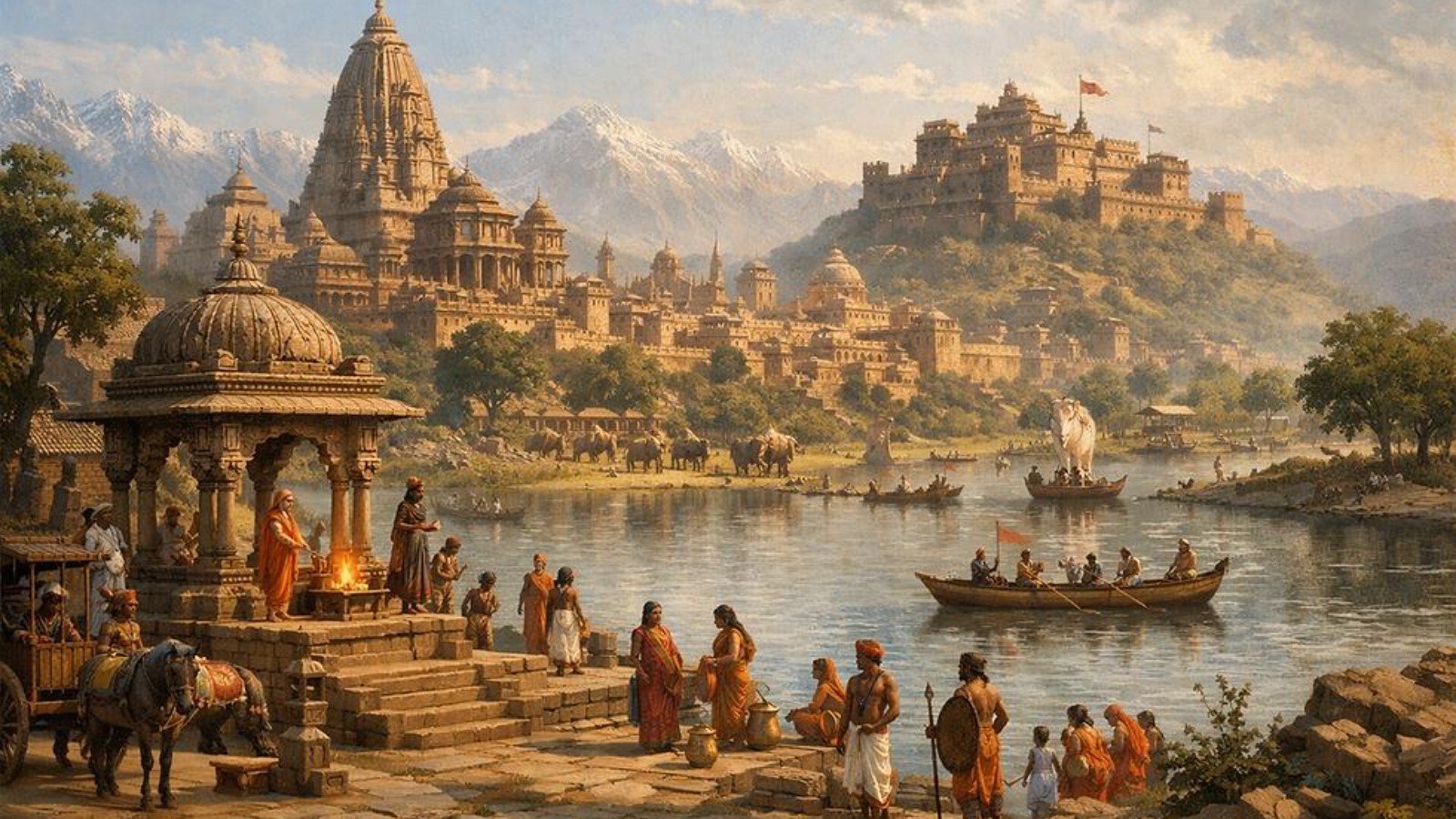
Introduction: The River That Time Forgot
Throughout human history, rivers have played a remarkable role in shaping civilisations. They provided water, supported agriculture, encouraged trade and became the foundations upon which some of the world's earliest societies developed. The Nile nurtured ancient Egypt, the Tigris and Euphrates supported Mesopotamia, and the Indus became the lifeline of one of the world's earliest urban civilisations.
But ancient Indian literature speaks of another river, one remembered with extraordinary reverence: the Saraswati.
Described in the Rigveda as a mighty and sacred river, Saraswati occupies a special place in India's ancient religious and cultural traditions. Its waters were celebrated in hymns, its name became associated with divine power, and its presence was woven into the spiritual imagination of generations.
Yet, unlike the great rivers that continue to flow across the Indian subcontinent, the Saraswati is no longer visible as a major flowing river today.
This raises an intriguing question: What happened to the river Saraswati?
Was it once a powerful geographical river that gradually disappeared due to environmental changes? Does it correspond to an ancient river system that can still be traced through geological evidence? Or did its identity gradually evolve from a physical river into a powerful religious and cultural symbol?
The search for answers takes us through ancient Sanskrit literature, archaeological discoveries, geological research and the history of India's earliest civilisations. It is a journey into a past where mythology and geography meet, but where many questions remain unanswered.
1. Saraswati in the Ancient Scriptures: More Than a River
One of the earliest and most important sources mentioning Saraswati is the Rigveda, one of the oldest surviving collections of Indo-Aryan religious poetry.
In the Rigveda, Saraswati is not presented merely as a small stream or an ordinary water source. She is celebrated as a powerful river, associated with abundance, strength and divine qualities.
One famous expression describes her as:
Ambitame, Naditame, Devitame.
This is commonly translated as:
Best of mothers, best of rivers, best of goddesses.
The expression captures the extraordinary importance attached to Saraswati. She was simultaneously understood through the language of nature and the language of divinity.
Several Vedic hymns describe her as a mighty, flowing force whose waters brought nourishment and prosperity. She was also associated with inspiration, sacred speech and the power of knowledge.
It is important to understand that the association between Saraswati as a river and Saraswati as a goddess developed over time. Early Vedic references give considerable attention to her river identity, while later religious traditions increasingly emphasise her connection with learning, music, wisdom and artistic expression.
For the communities that composed and preserved these hymns, rivers were not simply geographical features. They were essential sources of life, and their importance naturally found expression in religious thought.
The reverence for Saraswati may therefore preserve memories of a river that once held considerable significance in the lives of ancient communities.
2. Mapping the Lost River: Where Did Saraswati Flow?
One of the greatest challenges in understanding Saraswati is identifying its geographical location.
Unlike the Ganga or the Yamuna, which have clearly identifiable modern courses, the ancient Saraswati cannot be traced with certainty on a contemporary map.
A frequently discussed candidate is the Ghaggar-Hakra river system, an ancient drainage network that passes through present-day northwestern India and Pakistan.
The Ghaggar flows through parts of Haryana and Rajasthan before its channel becomes associated with the Hakra system in Pakistan's Cholistan region.
Researchers have investigated this landscape using satellite imagery, geological surveys, sediment analysis and the study of ancient river channels known as palaeochannels.
These investigations have revealed traces of former watercourses, suggesting that parts of this region experienced different river conditions in the distant past.
Some researchers have proposed that the Ghaggar-Hakra system corresponds, at least in part, to the river described in Vedic literature as Saraswati.
However, this identification remains debated.
Geological studies suggest that the ancient river network experienced changes in its water supply and drainage patterns. There is also evidence that major Himalayan rivers, including the Sutlej, once followed different courses through the region.
But the existence of ancient channels does not automatically establish that the entire Ghaggar-Hakra system was the Vedic Saraswati.
The exact location, extent and historical identity of the river remain subjects of continuing research.
This uncertainty is precisely what makes Saraswati such an interesting historical mystery.
3. The Civilisation Along Its Banks: Saraswati and the Harappan World
Perhaps the most fascinating part of the Saraswati mystery is its possible connection with the Indus Valley Civilisation, also known as the Harappan Civilisation.
Between approximately 2600 and 1900 BCE, the Harappan Civilisation flourished across a vast region of northwestern South Asia. It was one of the world's earliest urban civilisations, known for its carefully planned cities, sophisticated drainage systems, craft production, trade networks and impressive water-management practices.
While famous cities such as Harappa and Mohenjo-daro developed along the Indus river system, a considerable number of Harappan settlements have also been discovered along the Ghaggar-Hakra region.
Some important archaeological sites include:
Rakhigarhi: Located in Haryana, it is among the largest known Harappan urban sites.
Kalibangan: Located in Rajasthan, it is particularly known for its planned settlement, fire installations and evidence of an ancient ploughed field.
Banawali: An important Harappan settlement in Haryana, revealing different phases of urban development.
Bhirrana: Another significant archaeological site in Haryana, associated with early Harappan cultural remains.
The concentration of settlements in the Ghaggar-Hakra region has encouraged researchers to investigate whether an ancient river system supported these communities.
A particularly interesting scientific study published in 2019 examined sediment deposits along the Ghaggar and presented evidence that the river had experienced perennial phases during parts of the late Pleistocene and Holocene. The researchers suggested that renewed water supply associated with former Sutlej distributaries may have helped support early Harappan settlements.
However, the relationship between the river and the civilisation is more complicated than the idea of a single great river supporting every settlement.
Research published in Proceedings of the National Academy of Sciences in 2012 suggested that changing river conditions and weakening monsoon rainfall affected settlement patterns and agricultural practices. As water availability changed, communities adapted by modifying crops, relocating and establishing settlements in regions with more reliable rainfall.
This brings us to an important possibility: the decline of ancient river systems may have influenced the transformation of Harappan urban life, even if it was not the only reason for the civilisation's gradual deurbanisation.
The archaeological evidence does not conclusively establish that the Harappans called this river Saraswati. Nevertheless, the geographical overlap between ancient settlements and former river channels makes the connection an important subject of historical investigation.
4. The Disappearance: What Happened to Saraswati?
A river does not necessarily disappear overnight. It can gradually lose its water, change its course, divide into smaller channels or become seasonal.
The disappearance of the ancient river system associated with Saraswati is often explained through a combination of geological and climatic changes.
The shifting of Himalayan rivers
One major explanation involves changes in the courses of the Sutlej and Yamuna.
Over thousands of years, rivers in the northwestern Indian subcontinent experienced significant changes in their drainage patterns. Geological processes, erosion and sediment deposition can cause rivers to abandon old channels and establish new ones.
Some geological studies suggest that former Sutlej channels once supplied water to parts of the Ghaggar-Hakra system before the river shifted towards its present course.
Research into ancient sediments has provided evidence of these changing drainage patterns. However, the exact timing and relationship between individual river shifts remain subjects of scientific investigation.
The changing monsoon
Another important factor was the weakening of monsoon rainfall.
The Harappan world depended considerably on seasonal rainfall and river water. When rainfall patterns changed, agricultural communities faced increasing challenges.
Studies of the Indus civilisation indicate that declining monsoon strength around the late third millennium BCE contributed to environmental stress across several regions.
This did not necessarily mean that every river dried up completely. Instead, the reduction and increasing unpredictability of water availability may have made some settlements less suitable for large populations.
ectonic and geographical changes
The northwestern Indian landscape has also been shaped by tectonic movements over geological time.
Changes in land elevation and drainage gradients can influence the direction and behaviour of rivers. Combined with sediment accumulation and changing rainfall, such processes can gradually transform an entire river network.
It is important, however, not to attribute the disappearance of Saraswati to one dramatic earthquake or a single geological event. The available evidence points towards a complex history of environmental and hydrological change.
The transformation of a river landscape
As major water sources shifted and rainfall became less dependable, parts of the ancient river network gradually lost their perennial character.
Some channels continued to carry seasonal water, while others became dry or were transformed into smaller drainage systems.
The landscape that had once supported flourishing settlements increasingly became difficult for certain agricultural communities to inhabit.
The river may have disappeared as a major geographical feature, but its memory continued to survive in literature and religious traditions.
5. The Legacy of a River That Never Left
Although the physical river may have changed beyond recognition, Saraswati continues to occupy an important place in India's cultural imagination.
Her name appears in religious ceremonies, educational institutions, literature, music and artistic traditions. She is invoked by students before examinations, by musicians before performances and by scholars seeking wisdom.
The river's legacy also survives in the historical landscape of northwestern India.
The dry channels, archaeological remains and ancient settlements continue to attract researchers attempting to reconstruct the environmental history of the region.
The search for Saraswati is therefore not simply an attempt to locate a missing river. It is also an effort to understand how ancient communities interacted with their environment, how they responded to geographical changes and how their experiences became embedded in religious traditions.
There is something remarkable about the survival of this memory.
Civilisations rise and fall. Rivers change their courses, cities become ruins and landscapes transform. Yet stories can survive these changes, sometimes for thousands of years.
Saraswati represents this extraordinary relationship between nature, human memory and spirituality.
Conclusion: Can a River Disappear but Its Memory Survive?
The story of Saraswati is one of India's most fascinating historical mysteries.
It begins with the descriptions of a mighty river in ancient Vedic hymns, moves through the archaeological landscapes of the Harappan civilisation and continues into modern scientific investigations of buried river channels.
Along the way, it reveals a complex relationship between geography, climate, human settlement and religious belief.
We may never be able to establish every detail of the river's original course or conclusively identify it with a particular ancient drainage system. The evidence continues to be examined, and new discoveries may reshape our understanding.
But perhaps the most extraordinary part of the Saraswati story is not simply that a river may have disappeared.
It is that its identity survived.
A river that may once have nourished ancient settlements eventually became a symbol of knowledge, wisdom and creativity. Its waters may no longer flow as they once did, but its name continues to be spoken in prayers, written in books and celebrated in traditions across India.
Perhaps rivers do not disappear entirely when their waters dry up. Sometimes, they continue to flow through the memories of the people who once lived beside them.